The soil profile changes dramatically between San Diego's coastal mesas and its inland canyons. A job in Mission Bay might hit clean beach sand, while one in Rancho Bernardo drills into decomposed granite. These materials behave completely differently under load and moisture. Our grain size analysis in San Diego quantifies that difference precisely. We run the full curve from coarse gravel down to clay-sized particles using combined sieve and hydrometer methods. The resulting distribution tells you whether your fill will drain freely or retain water. For projects near the San Diego River or in artificial fill zones, we often pair the gradation work with an Atterberg limits determination because fines content alone cannot predict plasticity. The lab processes samples from downtown high-rises to East County subdivisions, always following the same rigorous ASTM standard.
A well-graded San Diego soil with a coefficient of uniformity above 6 for sands and above 4 for gravels locks particles together mechanically, reducing post-construction settlement.
Service characteristics in San Diego
Local geotechnical conditions in San Diego
A mixed-use building in the Midway District taught us a hard lesson about gradation assumptions. The geotechnical report from the 1980s classified the site as medium-dense sand, but during excavation the contractor hit pockets of silty sand with 35 percent passing the No. 200 sieve. The original drainage plan failed. A complete grain size analysis on the actual material revealed a gap-graded soil prone to internal erosion. We reran the hydrometer three times to confirm the fines percentage before the engineer redesigned the subdrain system. San Diego's alluvial deposits, especially near the San Diego River and its tributaries, hide these lenses more often than you would think. Getting the full particle-size distribution curve is not a formality. It is the difference between a permeable backfill that works and one that clogs within two rainy seasons.
Our services
Our San Diego soil lab processes gradation samples with a standard turnaround of three to five business days. We handle everything from single bag samples for septic system design to multi-location sampling programs for large linear infrastructure. Each report includes the full particle-size distribution table, a semi-logarithmic gradation curve, and USCS classification with the group symbol. Expedited service is available for construction-phase testing where the contractor needs compaction approval before the next lift.
Full Sieve + Hydrometer Package
Combined mechanical sieving and sedimentation analysis producing a complete grain size distribution curve from 3 inches to 0.001 mm. Includes percent gravel, sand, silt, and clay fractions with USCS classification per ASTM D2487.
Wash Sieve Analysis
Determination of the amount of material finer than the No. 200 sieve by washing. This single-point test is useful for quality control of concrete aggregates, filter sands, and base course materials where the fines content must stay below a specified threshold.
Hydrometer-Only Analysis
Sedimentation analysis for fine-grained soils when the sand and gravel fractions are negligible. We report the clay-size fraction percentage, critical for assessing the activity of the soil and its swell potential in San Diego's expansive clay formations.
Frequently asked questions
How much does a grain size analysis cost in San Diego?
A standard sieve plus hydrometer analysis in our San Diego lab runs between US$100 and US$210 per sample, depending on whether you need the full curve or just the wash sieve. Expedited turnaround adds a surcharge. We quote multi-sample projects at a reduced per-unit rate.
What is the difference between a sieve analysis and a hydrometer analysis?
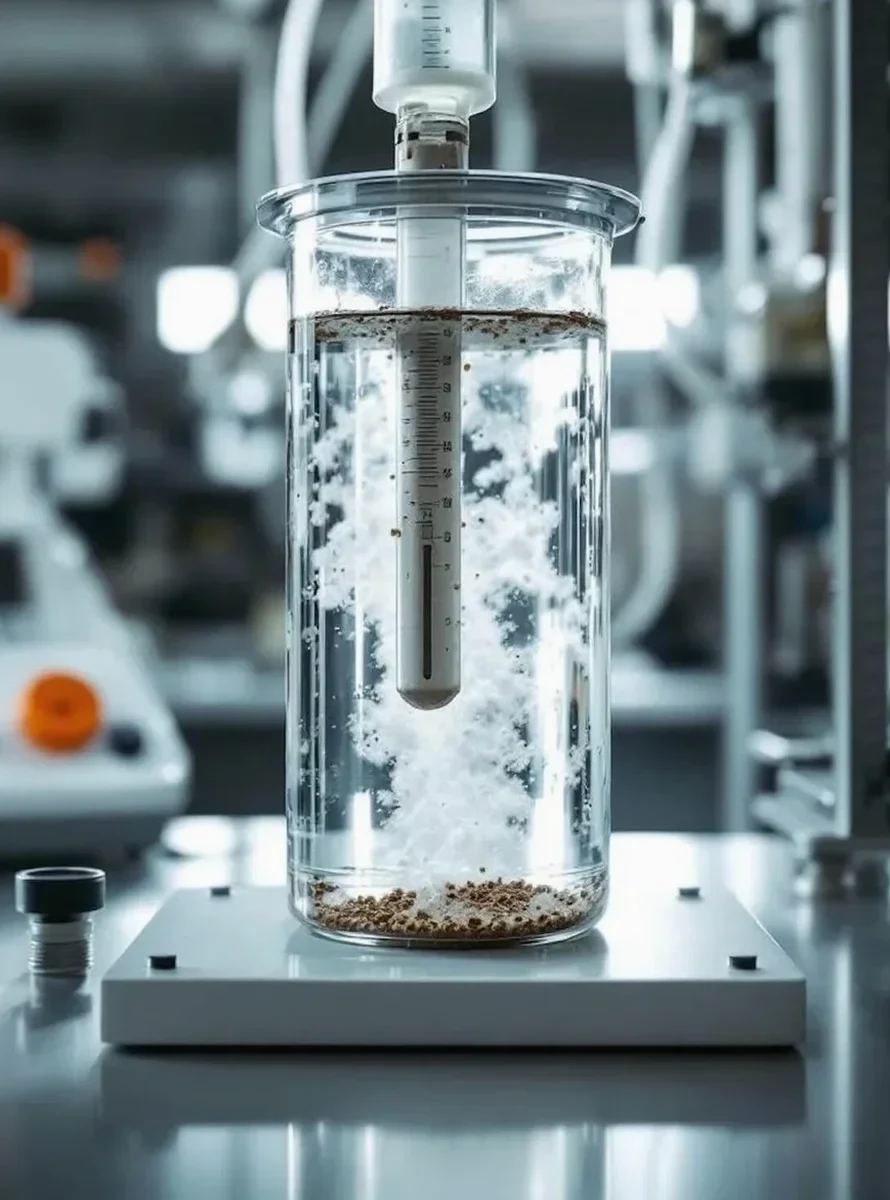
Mechanical sieving separates particles larger than 75 microns (No. 200 sieve) by shaking them through a stack of progressively finer screens. The hydrometer analysis handles the minus-200 material. It measures the settling velocity of particles in a water column using Stokes' law. A complete grain size analysis in San Diego requires both because many local soils contain a mix of coarse and fine fractions.
How much sample material do you need?
For a combined sieve and hydrometer analysis, we need approximately 500 grams of material passing the No. 4 sieve. If the soil contains significant gravel, we require a larger bulk sample of 5 to 50 kg to ensure the coarse fraction is representative. We can provide sampling bags and instructions for your field crew.
How do you classify the soil from the gradation data?
We apply the Unified Soil Classification System per ASTM D2487. The percentages of gravel, sand, and fines determine the major division. The shape of the gradation curve gives the coefficients of uniformity and curvature, which tell us whether the soil is well-graded or poorly-graded. For fine-grained soils, we combine the gradation with Atterberg limits to assign a group symbol like CL, ML, or CH.