A common mistake in San Diego hillside construction is treating a 12-foot cut in Friars Formation sandstone the same as a fill slope in Mission Valley alluvium. The failure mode is different, the drainage demand is different, and the surcharge from an adjacent canyon-lot footing changes everything. We see this when contractors submit city permits with generic Caltrans standard sheets that do not match the site's geotechnical report. Our retaining wall design process starts with the site-specific soil profile: residual claystone with expansive potential east of the 15, beach terrace deposits near La Jolla where groundwater sits at 10 feet, and engineered fill across former river channels in Mission Valley. For walls over 4 feet, San Diego Development Services requires a signed design from a California-licensed engineer, and the slope stability analysis becomes critical when the wall supports a descending driveway or pool deck on a canyon lot.
A retaining wall in San Diego is a seismic resisting element, not just a landscape feature — the design must handle 0.25g lateral acceleration and a saturated backfill scenario simultaneously.
Service characteristics in San Diego
Local geotechnical conditions in San Diego
A Link-Belt 210 excavator with a 42-inch bucket opens the trench for a soldier pile wall in a Pacific Beach backyard, and within three feet the spoil turns from dry sand to saturated gray silt. That is the groundwater table the developer's desktop study placed at 15 feet; it is actually at 6. The wall design changes on the spot: embedment depth increases, the passive resistance zone shrinks, and the tieback bond length must extend past the seepage zone. San Diego's canyon hydrology is unpredictable because irrigation runoff, broken storm drains, and perched water in terrace deposits create localized saturation that boring logs alone do not always capture. A wall built without accounting for hydrostatic pressure behind the stem will tilt within two wet seasons. We have seen it on Clairemont Drive and in Encanto. The cost to retrofit a failed wall with tiebacks and a new drainage system runs triple the original construction budget. The way to avoid this is simple: specify a conservative groundwater assumption, design the drain to handle ten times the calculated flow, and never let a contractor skip the weep holes because 'the soil looks dry.'
Our services
Ofrecemos un portafolio completo de servicios técnicos de diseño de muros de contención diseñados para proyectos de construcción, minería e infraestructura en San Diego.
Cantilever Retaining Wall Design
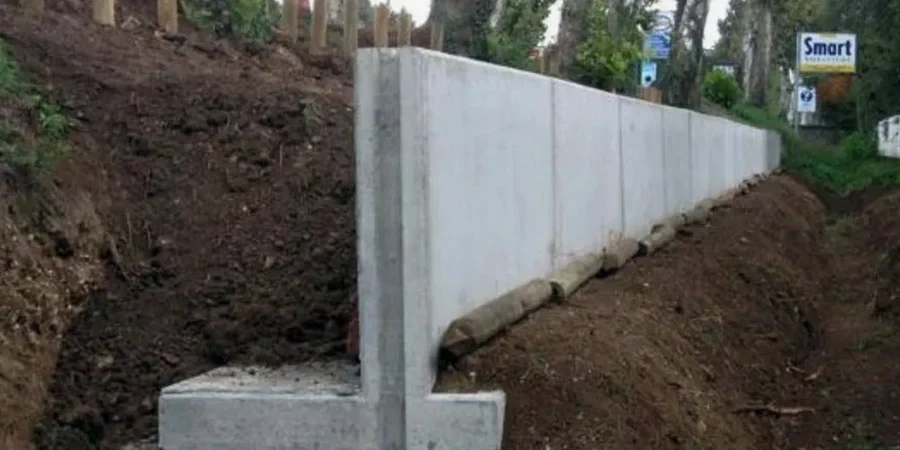
Reinforced concrete cantilever walls for heights up to 20 feet on competent bearing soils. Includes stem, heel, toe design per ACI 318 and seismic earth pressure calculation per ASCE 7-22. Suitable for San Diego residential and commercial lots where excavation width is not restricted.
Soldier Pile and Lagging Wall Design
Steel H-pile walls with reinforced concrete or timber lagging for canyon cuts, basement excavations, and sites with zero lot-line clearance. Tieback anchors designed where cantilever embedment depth is insufficient. Common in Bankers Hill, Mission Hills, and La Jolla hillside projects.
MSE Wall and Segmental Block Wall Design
Mechanically stabilized earth walls using geogrid reinforcement and segmental concrete facing. Designed per FHWA and Caltrans standards for fill applications, roadway embankments, and tiered walls on large residential lots. Internal and external stability checked for seismic loading.
Retaining Wall Condition Assessment
Forensic evaluation of existing retaining walls showing distress: cracking, tilting, or drainage failure. Includes backfill investigation, rebar corrosion assessment, and stability re-analysis. Used by property owners, HOAs, and real estate professionals before listing canyon-edge properties in San Diego.
Frequently asked questions
What does a retaining wall design package cost in San Diego?
For a typical San Diego residential retaining wall between 4 and 10 feet high, the structural and geotechnical design package runs from US$980 to US$3,590. The fee depends on wall height, proximity to property lines, surcharge conditions from adjacent structures, and whether the project is in a liquefaction zone per California Geological Survey Seismic Hazard Zone maps. A 4-foot planter wall on a flat lot falls at the lower end; a 12-foot soldier pile wall with tiebacks on a canyon lot near a mapped fault trace falls at the upper end. The package includes site review, stability calculations, City-compliant drawings, and the signed engineering report required for the building permit application.
Which retaining wall types work best in San Diego's geology?
It depends on the formation. In the Friars and Scripps formations east of I-15, cantilever walls on spread footings perform well because the cemented sandstone has good bearing capacity. In the marine terrace deposits of La Jolla and Point Loma, soldier pile walls with concrete lagging manage the sandy, poorly consolidated soils without extensive shoring. For fill sites in Mission Valley and the Otay River basin, MSE walls with geogrid reinforcement absorb differential settlement better than rigid structures. We avoid unreinforced gravity walls in any location where the design earthquake produces a horizontal acceleration above 0.25g.
How long does the city permit review take for a retaining wall?
For a standard residential retaining wall under 10 feet not supporting a surcharge, San Diego Development Services typically completes plan check within 2 to 4 weeks if the submittal includes a complete geotechnical report and structural calculations. Walls over 10 feet, or any wall supporting a structure or driveway, require a more detailed review and may trigger an additional grading plan check, which can extend the timeline to 6-8 weeks. We submit directly to the online permit portal and handle reviewer comments so the contractor does not lose time on resubmittals.
Do I need a geotechnical investigation before the retaining wall design?
Yes. The City of San Diego will not accept a retaining wall design without a site-specific geotechnical investigation that includes exploratory borings, laboratory testing, and a signed report from a California-licensed geotechnical engineer. The investigation establishes the soil profile, bearing capacity, groundwater level, and seismic site class. We often combine the geotechnical exploration with the design package so the same team handles both the subsurface characterization and the wall engineering, which avoids discrepancies between the soils report and the structural drawings.
What drainage details are required for retaining walls in San Diego?
Every wall we design includes a continuous gravel chimney drain behind the stem, a perforated collection pipe at the base, and weep holes spaced no more than 8 feet on center. For walls retaining expansive clay soils common in eastern San Diego neighborhoods like Rancho Peñasquitos, we widen the drain zone and specify a geotextile filter fabric to prevent fines from clogging the gravel. If the wall is near a swimming pool or irrigated landscape, we add a waterproofing membrane on the back face and up-size the drain pipe to handle concentrated flow from area drains and downspouts.