San Diego's geotechnical landscape demands direct observation. The 2022 California Building Code (Title 24, Part 2) incorporates IBC Chapter 18, requiring thorough subsurface exploration. Seismic Design Category D applies across much of the metro area due to proximity to the Rose Canyon Fault Zone—a right-lateral strike-slip system running through downtown. An exploratory test pit lets our team expose soil profiles visually, log stratigraphy per ASTM D2488, and collect bulk samples from the stadium conglomerate, Ardath Shale, or recent alluvium that underlie neighborhoods from La Jolla to Chula Vista. We've used this method in tight utility corridors where a CPT rig cannot physically access, and in canyon fills where undisturbed sampling is critical for slope stability evaluation before grading permits are issued.
A single test pit in the Mission Valley alluvium can tell you more about cobble size and groundwater than ten borings combined.
Service characteristics in San Diego
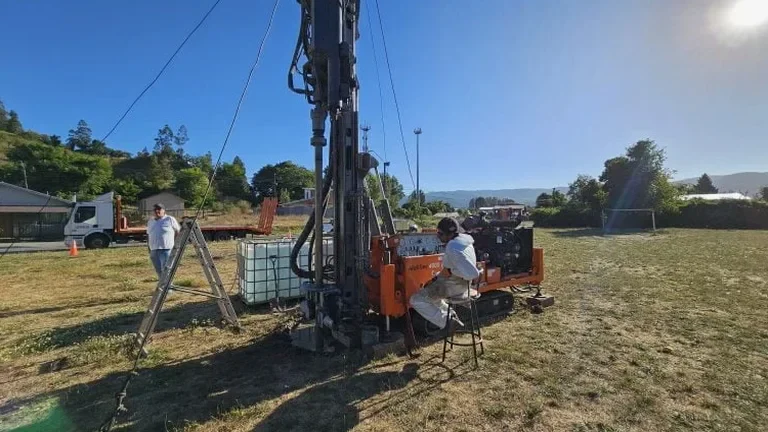
Demonstration video
Local geotechnical conditions in San Diego
A 20-ton hydraulic excavator with a 24-inch to 36-inch bucket digs the pit while our field engineer stands at the edge directing the operation. The primary hazard in San Diego is caving ground—dry granular alluvium or loose fill can ravel without warning. Any pit deeper than 4 feet requires shoring, benching, or sloping per Cal/OSHA T8 CCR Section 1541.1, and we enforce a strict no-entry protocol below 5 feet unless a protective system is in place. Gas monitoring runs continuously when working in older urban districts like Barrio Logan or near former landfills, where methane migration is a known issue documented by the County DEH. Traffic control, overhead clearance from SDG&E primaries, and vibration monitoring adjacent to historic unreinforced masonry buildings add layers of complexity we manage routinely.
Our services
Our exploratory test pit package covers the complete field-to-report workflow for San Diego projects—from utility clearance (USA North 811) through logging, sampling, and backfill compaction testing.
Subsurface Logging & Profiling
Detailed stratigraphic columns mapped in the field following the visual-manual procedure of ASTM D2488. We identify fill, Stadium Conglomerate, weathered shale, and colluvium, recording moisture, consistency, and layering directly from the pit face.
Bulk & Disturbed Sampling
Collection of 5-gallon bucket samples or bag samples from specific horizons for laboratory index testing—grain size distribution, Atterberg limits, and R-value determination for pavement subgrade characterization.
In-Situ Density Verification
Post-backfill compaction testing using the sand cone method (ASTM D1556) on lift-by-lift basis to verify the backfill meets the project's relative compaction specification, typically 90% per Caltrans Standard Specifications.
Frequently asked questions
What's the cost range for an exploratory test pit in San Diego?
For a typical single pit excavated to 8–10 feet depth with standard logging and sampling, the cost ranges from US$530 to US$800. This includes USA North 811 utility clearance, the excavator with operator, our geotechnical engineer for field logging, and post-excavation backfill with compaction testing. Costs rise if traffic control plans, shoring, or gas monitoring are required by site conditions.
How does a test pit compare to a soil boring for shallow exploration?
A test pit provides continuous, full-scale visual exposure of the soil profile, whereas a boring yields a small-diameter disturbed sample or SPT split spoon. The pit reveals cobble size, fissures, slickensides, and seepage patterns directly. For shallow foundation design, utility alignments, and landslide evaluation, that visual certainty reduces interpretation risk significantly.
What safety measures apply to test pits in urban San Diego?
We follow Cal/OSHA T8 Section 1541.1 strictly: pits deeper than 4 feet require sloping, benching, or shoring. A competent person inspects the excavation before entry. In older urban zones, we run continuous gas monitoring for methane and hydrogen sulfide. Traffic control and overhead utility clearance are coordinated with the City of San Diego Right-of-Way permit requirements.
Can you backfill and compact the pit after sampling?
Yes, we backfill in lifts using the excavated material or imported engineered fill. Each lift—typically 8 to 12 inches loose—is compacted with a vibratory plate or jumping jack. We verify density with a nuclear gauge or sand cone per ASTM D1556 and document results against the project's specified relative compaction.