The mix of coastal bluffs, steep canyons, and dissected mesas across San Diego County—from La Jolla to Rancho Bernardo—creates a real patchwork of fill and cut conditions that demand rigorous compaction verification. When a contractor places engineered fill on a Mission Valley pad or backfills a sewer trench in Carlsbad, the question is always the same: did it hit the 90 or 95 percent relative compaction the geotechnical report specified? That is where the field density test (sand cone method) earns its place. It gives us a direct, physical measurement of in-place density that no nuclear gauge reading can dispute. Our technicians run ASTM D1556 procedures on sites from Chula Vista to Escondido, and we cross-check the results with lab Proctor curves produced under ASTM D698 or D1557. Because San Diego’s geology swings from Stadium Conglomerate to friable Santiago Peak volcanics, the moisture-density relationship can shift within a single grading day, and catching that early saves rework.
A sand cone test measures one lift in one spot—but when placed within a well-documented testing grid across the entire San Diego pad, it becomes a defensible record of compaction quality.
Service characteristics in San Diego
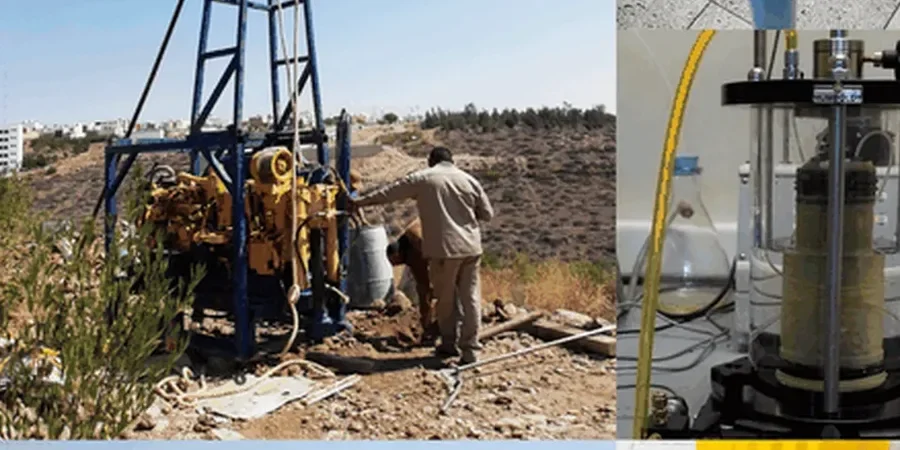
Local geotechnical conditions in San Diego
A hillside subdivision in San Carlos sat on a canyon fill prism that reached 45 feet at its deepest point. The grading contractor placed lifts at ten inches and ran compaction with a sheepsfoot roller, but the first round of sand cone tests showed dry densities hovering around 88 percent of the modified Proctor maximum. The moisture content was three points below optimum, so the clayey sandstone fill was bridging rather than knitting. We flagged the zone before the next lift went down, the contractor adjusted water and remixed the material, and the follow-up tests cleared 93 percent compaction. That adjustment took a single afternoon. Had the fill been accepted at 88 percent, differential settlement could have cracked slab-on-grade foundations and dragged the street pavement with it. In San Diego’s canyon neighborhoods—Tierrasanta, Scripps Ranch, Del Cerro—deep fill compaction is not a statistical exercise; it is the difference between a pavement that lasts twenty years and one that develops alligator cracking in three.
Our services
Compaction verification in San Diego rarely stops at a single test method. We support grading contractors, geotechnical firms, and public agencies with a coordinated set of field and laboratory services that keep earthwork on schedule.
Grading pad and structural fill compaction testing
Systematic sand cone testing on building pads, road subgrades, and retaining wall backfill across San Diego, with real-time density and moisture reporting tied to the project’s Proctor curve.
Utility trench backfill verification
Lift-by-lift density checks in sewer, water, and storm drain trenches from downtown San Diego to North County, following Caltrans frequency tables and local agency addenda.
Proctor laboratory correlation
Standard and modified Proctor tests on bulk samples taken directly from the compacted lift, ensuring that the reference curve matches the material actually placed on site.
Frequently asked questions
How much does a field density test in San Diego cost?
A single sand cone field density test, including the technician's time, equipment, and same-day result, typically runs between US$110 and US$150. The total project cost depends on the number of tests required per day and the travel distance within San Diego County. We provide a per-visit quote that covers the full testing grid specified in the geotechnical report so there are no surprises.
When is the sand cone method preferred over a nuclear density gauge in San Diego?
The sand cone method becomes the go-to choice when the soil contains aggregates larger than about an inch, when the material is highly variable, or when the project specifications or local jurisdiction require a direct volume measurement that does not rely on radiation backscatter calibration. In San Diego’s decomposed granite and conglomerate fills, the physical sand cone test avoids the calibration drift that can affect nuclear gauges in heterogeneous ground.
How many tests do I need for a typical San Diego building pad?
The International Building Code and most San Diego geotechnical reports specify a minimum frequency of one field density test per 2,500 square feet per lift, or one test per 50 linear feet of utility trench per lift. If the fill material changes—say from friable volcanics to clayey sandstone—the geotechnical engineer may increase the frequency to capture the variability. We work directly with the project geotechnical engineer to adjust the testing grid as site conditions evolve. More info.