San Diego sits on a complex geological mosaic — from the granitic bedrock of the Peninsular Ranges to the marine terraces and alluvial deposits that define its coastal mesas. With more than 1.3 million residents and a construction sector that added over 9,000 residential units in 2023 alone, the demand for reliable soil parameters has never been higher. The triaxial test provides exactly that: a controlled laboratory procedure to determine the effective shear strength of a soil specimen under confining pressure. Unlike simpler index tests, it replicates the in-situ stress state so the design team can assess how the ground will actually behave under load. For projects near Mission Valley’s soft sediments or the engineered fills of Otay Mesa, this level of precision is not a luxury. It is the difference between a foundation that performs and one that surprises you during excavation.
A well-executed triaxial test gives you the friction angle and cohesion you actually need — not just generic textbook values that hide the real risk in your San Diego site.
Service characteristics in San Diego
Local geotechnical conditions in San Diego
San Diego’s urban expansion into relict canyon fills and engineered plateaus has created a recurring problem: undocumented fill layers that look competent during a standard boring log but fail to develop the shear strength assumed in the structural model. The triaxial test exposes these weak zones before construction starts. When a developer skips advanced strength testing, the project inherits a hidden liability — retaining walls that tilt, mats that settle differentially, or slopes that creep after the first heavy rain. The International Building Code (IBC) and ASCE 7 require a defensible basis for allowable bearing capacity and lateral earth pressure, especially in Seismic Design Category D, which covers most of coastal San Diego. Triaxial data, properly interpreted, satisfies that requirement and gives the geotechnical engineer the confidence to optimize foundation dimensions rather than overcompensating with conservatism that drives up concrete and steel quantities.
Our services
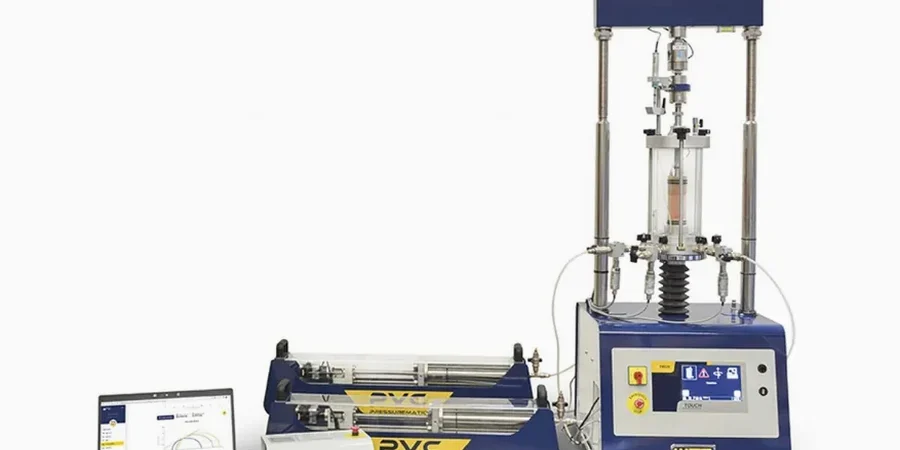
Our triaxial testing program in San Diego is designed to deliver parameters that engineers can use immediately in their design software — no black-box results, no unreported assumptions. Each test includes full stress-strain curves, pore pressure evolution, and Mohr-Coulomb failure envelopes.
Consolidated-Undrained Triaxial with Pore Pressure
The standard for effective stress analysis. We saturate the specimen under back pressure, consolidate it to the in-situ stress, and shear it at a slow rate while recording excess pore pressure. You get c' and φ' for drained long-term design.
Unconsolidated-Undrained Triaxial
Used for short-term stability during construction. The specimen is sheared without consolidation, giving total stress parameters that apply to rapid loading cases such as excavation support and temporary berms.
Multi-Stage Triaxial with Stress Path Control
When sample availability is limited, one specimen can be sheared in stages at increasing confining pressure. This method reduces lab time while still producing a reasonable failure envelope for preliminary design phases.
Frequently asked questions
How many triaxial tests do I need for my San Diego project?
The number depends on site stratigraphy and project risk. A typical single-family lot with uniform soil might require three specimens (one set of CU or UU), while a mid-rise building on variable alluvium in Kearny Mesa could need six to nine specimens to capture the range of soil types with depth. We recommend at least one triaxial test per distinct soil layer that will carry significant foundation load.
What is the difference between a CU and a UU triaxial test?
A consolidated-undrained (CU) test allows the specimen to consolidate under confining pressure before shear, and we measure pore pressure during loading to compute effective stresses. It gives c' and φ' for long-term drained analysis. An unconsolidated-undrained (UU) test does not allow drainage at any stage and yields total stress parameters (c and φ) used for short-term conditions during construction.
What does triaxial testing cost in San Diego?
A full triaxial program typically ranges from US$1,810 to US$2,890, depending on the number of specimens, the test type (CU vs. UU), and whether undisturbed sampling requires specialized field equipment. The investment is modest compared to the cost of redesigning a foundation after construction reveals unexpected soil behavior.
How long does it take to get triaxial test results?
A standard CU triaxial set on cohesive soil takes about two to three weeks from sample arrival to final report. Consolidation and shear phases are slow by design — rushing them produces unreliable data. If your schedule is tight, let us know early and we can often stage the work to deliver preliminary parameters before the full report is complete. More info.