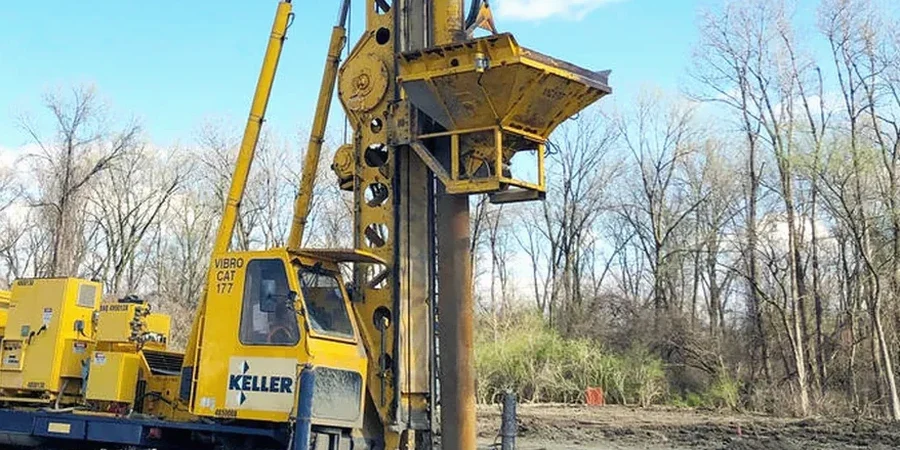
The V32 vibrator hangs from a 100-ton crawler crane, its eccentric weight spinning at 1800 rpm. Water jets flush at 80 psi through the nose cone. On a Mission Valley lot, we lower it into loose alluvium at 45-foot depth. The probe compacts radially. Sand grains rearrange into a denser state. The rig runs on 480-volt diesel generators. Noise level at 50 feet stays under 85 dBA. Vibration amplitude reads 0.8 inches peak-to-peak on the accelerometer. Each probe penetration point follows a triangular grid at 7-foot spacing. We log amperage draw every foot. The operator watches the digital readout. Resistance rises as the soil tightens. Backfill trickles from the hopper to maintain grade. For sites with silty interbeds, the stone columns technique adds drainage and stiffness where pure vibrocompaction loses efficiency.
We achieve 70% relative density in clean sands with a 7-foot triangular grid and 45-foot probe depth.
Service characteristics in San Diego
Demonstration video
Local geotechnical conditions in San Diego
La Jolla sits on hard sandstone. Point Loma on Cretaceous-age rock. But Mission Bay and the Midway District rest on loose hydraulic fill placed between 1940 and 1960. Same city, radically different subsurface risk. A vibrocompaction design that works in Kearny Mesa's residual granite won't function in the 30-foot-deep fills of East Village. The fill contains debris, organics, and variable silt lenses. That's where we switch to a stone columns approach or hybrid vibro-replacement. Liquefaction triggering analysis per ASCE 7-22 Chapter 21 drives the decision. We run SPT-based and CPT-based triggering correlations. Factor of safety against liquefaction must exceed 1.3 for critical structures. Post-treatment verification borings confirm the design. A site with N-values jumping from 8 to 22 blows per foot means the grid worked. No liquefaction. No differential settlement. Just a densified mass of sand ready for spread footings.
Our services
Our vibrocompaction design package in San Diego includes pre-treatment site characterization, grid layout engineering, and post-densification verification. We coordinate directly with specialty contractors operating V23, V32, and V48 vibroflots.
Pre-treatment CPT and SPT Investigation
Deploy electric cone penetration testing to 80-foot depth to map loose zones. Correlate tip resistance and friction ratio to relative density. Supplement with mud-rotary SPT borings for sampling.
Grid Design and Liquefaction Analysis
Develop triangular grid parameters based on gradation and target density. Run liquefaction triggering analysis using NCEER and Boulanger & Idriss (2014) procedures. Specify probe depth, amperage cutoff, and backfill gradation.
Post-treatment Verification Testing
Execute CPT and SPT borings at 5% of production probe locations. Compare pre- and post-treatment penetration resistance. Issue signed report certifying densification meets ASCE 7-22 requirements.
Frequently asked questions
How much does a vibrocompaction design package cost in San Diego?
A full design package including pre-treatment CPT borings, grid engineering, liquefaction analysis, and post-treatment verification typically ranges from US$1,260 to US$5,840. The final cost depends on treatment area size, probe depth, and the number of verification borings required by the project geotechnical engineer.
What minimum fines content makes vibrocompaction ineffective?
Vibrocompaction loses efficiency when fines content exceeds 12 to 15 percent. The silt fraction dampens vibration transmission and prevents sand grain rearrangement. We run a hydrometer analysis (ASTM D422) on every sample before specifying pure vibrocompaction. For soils with 15 to 30 percent fines, we evaluate vibro-replacement or stone columns as alternatives.
How do you verify the ground improvement meets the design specification?
We run post-treatment CPT soundings and SPT borings at 5 percent of the production probe locations, spaced on a staggered grid offset from the treatment points. The acceptance criterion is typically a minimum corrected SPT N-value of 20 blows per foot or a CPT tip resistance exceeding 120 tsf, depending on the target relative density specified in the project geotechnical report.